
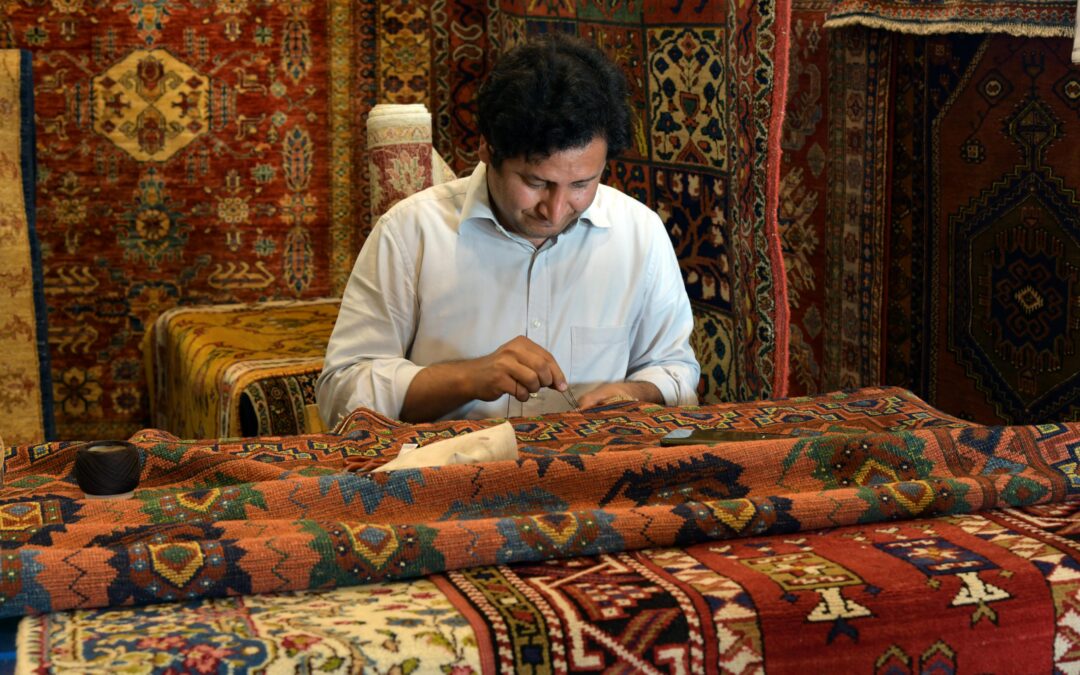
When you walk into our showroom on Sacramento Street and unroll a hand-knotted Turkish rug, you're looking at months; sometimes years of human work. Not metaphorically. Literally. Every knot in that rug was tied by a person. Our owner Cengiz has been working with Turkish rugs since 1989, and we want to show you what goes into making one.
It Starts with the Wool
A real Turkish rug begins long before the loom. It begins with the sheep.
The best Turkish rugs use wool from mountain sheep raised in regions like Anatolia — animals that graze on tough grasses at high elevation, develop dense coats for harsh winters, and produce wool that's naturally strong, lustrous, and rich in lanolin. This is the wool you want in a rug. It takes dye beautifully, resists soiling, and lasts for generations.
After shearing, the wool is:
- Cleaned: Washed by hand in cold running water to remove grease and debris
- Carded: Combed to align the fibers in one direction
- Spun: Traditionally by hand on a drop spindle, though many modern workshops use wheel spinning
- Dyed: This is where the magic happens
The Dyes Tell You Everything
A master weaver can look at a 100-year-old rug and tell you roughly what decade it was made based on the dye colors alone. That's because traditional Turkish rug dyes come from natural sources — roots, leaves, insects, minerals — and different regions used different plants based on what grew nearby.
Common traditional dye sources:
- Madder root: reds and oranges, one of the most important natural dyes in rug history
- Indigo: deep blues, fermented from indigo plant leaves
- Weld: yellows and greens (when combined with indigo)
- Walnut husks: warm browns
- Pomegranate rind: soft golds and olive tones
- Cochineal: bright reds, from dried insects
- Iron mordants: used to darken colors and create blacks
Synthetic dyes became common in the 20th century, and for good reason — they're cheaper, more consistent, and produce a wider color range. But the best workshops still use natural dyes for their finest rugs because the colors age differently. A naturally-dyed rug develops "abrash"; subtle color variations within a single shade — that give old rugs their warmth and depth. A synthetic-dyed rug stays flat.
When we select rugs for our San Francisco showroom, we look for this kind of character. It matters.
The Loom and the Weaver
A Turkish rug is woven on a vertical loom. The warp threads (the structural foundation) run up and down. The weaver sits in front of the loom — sometimes on the floor, sometimes on a wooden bench; and ties each knot by hand.
The specific knot used in Turkish rugs is called the Turkish knot or symmetrical knot (also known as the Ghiordes knot). It wraps around two warp threads symmetrically. Persian rugs use a different knot — the asymmetrical or Senneh knot — which wraps around one warp thread and passes loosely under the next. Both create beautiful rugs, but they produce slightly different textures and are traditional to different regions.
How many knots are we talking about?
- A low-density Turkish rug might have 60-100 knots per square inch
- A medium-density rug has 150-250 knots per square inch
- A fine rug has 400-600 knots per square inch
- Master-quality silk rugs can exceed 1,000 knots per square inch
Now do the math. An 8x10 foot rug is 11,520 square inches. At 200 knots per square inch, that's over 2.3 million knots. Tied by hand. One at a time.
An experienced weaver can tie about 8,000-10,000 knots per day. A fine 8x10 rug takes one weaver roughly 8-12 months of full-time work. A master-quality silk rug can take 2-3 years.
What You're Looking At When You Look at the Back
Flip a real Turkish rug over and look at the back. You can see every knot. The pattern on the back is almost as clear as the pattern on the front — sometimes clearer, because the back isn't affected by pile wear.
This is the easiest way to tell a hand-knotted rug from a machine-made imitation:
- Hand-knotted: The back shows individual knots, often slightly irregular. You can see the weaver's rhythm — faster in some places, tighter in others. A human made this.
- Machine-made: The back is perfectly uniform, often with a grid-like backing or glue visible. A machine made this.
Hand-knotted rugs also have another tell: the weaver almost always introduces a small intentional imperfection somewhere in the pattern. This comes from a traditional belief that "only God is perfect" — so a human-made rug should never be. Find the imperfection and you're looking at a real one.
Finishing the Rug
Once the weaving is complete, the rug isn't ready yet. It still needs:
- Cutting off the loom — the warp threads are cut, and the rug is released. The ends become the fringe.
- Shearing — the pile is sheared to an even height. Master weavers do this by hand with scissors, adjusting the height in different areas to create subtle sculptural effects.
- Washing — the rug is washed to remove loom dust, loose wool, and any residual dye. This first wash also helps the colors settle and the rug find its final shape.
- Stretching and drying — the rug is stretched on a frame and dried flat in the sun. This sets the final dimensions.
- Final inspection — experienced eyes check every inch for weaving errors, dye irregularities, or damage.
Only then is the rug ready to travel — packed, shipped, and eventually unrolled in a showroom like ours on Sacramento Street.
Why This Matters When You're Buying a Rug
When someone tells you a hand-knotted Turkish rug costs $5,000 or $15,000 or $30,000, it can feel like a lot. Compared to a $500 machine-made rug from a big box store, it's 10x or 20x the price.
But now you know what you're paying for:
- Wool from specific regions, processed by hand
- Natural or high-quality synthetic dyes
- Months or years of human craftsmanship
- A product that will last 50-100 years with proper care
- A piece of art that can actually appreciate in value
A good oriental rug is one of the only things you can buy new that will outlast you and be worth more to your grandchildren. That's not marketing copy. That's a fact of the market for hand-knotted rugs.
Our Connection to Turkey
Cengiz started working with Turkish weaving workshops in 1989, and he's been importing rugs directly for Boga Rugs in San Francisco since 2007. We know the families. We've visited the looms. When we bring a rug back to San Francisco, we know the story behind it — the region, the materials, sometimes even the weaver.
When you visit our showroom, we're happy to walk you through what you're looking at. Why this rug is older than that one. Why this one has more knots per square inch. Why the colors in this one came from roots and this one came from a factory. If you've ever wondered "what makes this rug worth what they're asking?" — we have time to answer that question.
Come See the Difference
You can read about hand-knotted rugs all day. But until you stand over one, feel the pile, flip the corner to see the back, and really look at the work — it's hard to understand.
Visit our showroom: 3499 Sacramento St, San Francisco, CA 94118 Call us: (415) 567-1965 Free pickup and delivery throughout the San Francisco Bay Area