
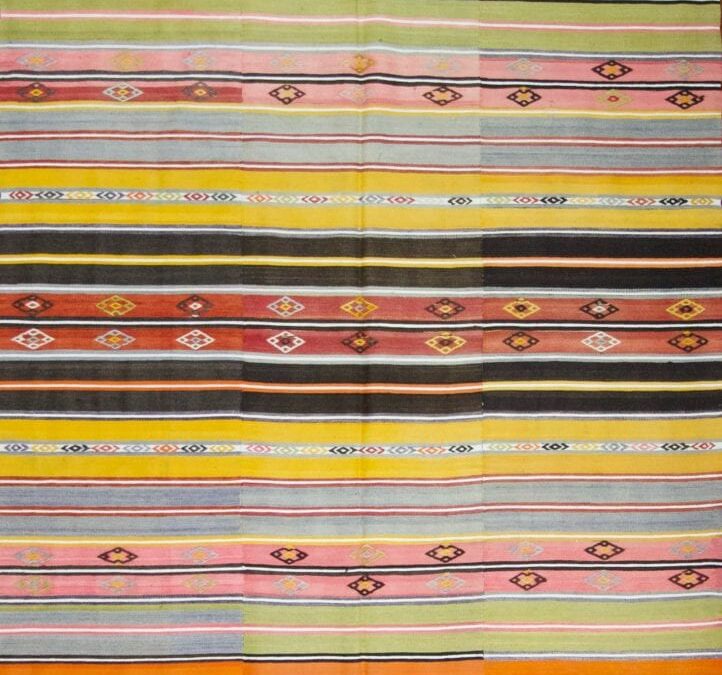
Most people hear "oriental rug" and picture a thick, plush pile rug. Kilims are the other half of the tradition. They're flat-woven, thin, lightweight, reversible, and visually bold. They're also one of the most versatile and accessible ways to bring handmade textile art into your home.
At Boga, we carry about 100 kilims in our showroom at any given time. They're some of our most popular pieces, especially with customers who want something authentic and handmade but are looking for a different aesthetic than a traditional pile rug.
What Makes a Kilim a Kilim
The fundamental difference between a kilim and a pile rug is construction. A pile rug is made by tying individual knots around the warp threads, creating a dense, raised surface. A kilim is flatwoven. There are no knots. Instead, colored weft threads are woven horizontally through vertical warp threads, with the weft packed tightly to completely cover the warp.
Because there's no pile, a kilim is:
- Thinner — typically 1/4 to 1/2 inch thick, compared to 1/2 to 1 inch for pile rugs
- Lighter — significantly easier to move, roll, and hang
- Reversible — both sides look essentially the same
- More graphic — without the softening effect of pile, patterns are crisp and defined
The Slit-Weave Technique
The classic kilim construction method is called slit-weave. When two colors meet along a vertical line, each color's weft turns back on itself rather than interlocking with the adjacent color. This creates a tiny gap — a "slit" — at the color boundary.
These slits are the signature of kilim construction. Run your finger along a color boundary on a kilim and you'll feel it. On a well-woven kilim, the slits are small and tight.
Where Kilims Come From
Anatolian (Turkish) kilims. Among the most collected and admired in the world. Bold and graphic, with strong geometric patterns, rich reds and blues. Regional variations are enormous — a kilim from eastern Turkey looks nothing like one from the Aegean coast. Turkey is arguably the heartland of kilim weaving, and it's where much of our inventory originates.
Persian kilims. Iran produces kilims alongside its famous pile rugs, tending toward more intricate patterns, sometimes incorporating curvilinear elements unusual in flatweave.
Afghan kilims. Deep, saturated colors — especially reds and blacks — and bold geometric patterns. Afghan kilims tend to be thicker and heavier than their Turkish counterparts.
Caucasian kilims. Relatively rare and highly collected, with strong geometric patterns and a raw, tribal quality.
Moroccan kilims. Often minimalist, with bold stripes and simple geometric elements in muted, earthy tones. Popular in contemporary design.
How to Evaluate a Kilim
Tightness of weave. Hold the kilim up to the light. On a tightly woven piece, you'll see very little light coming through. Tighter is better.
Color consistency. Minor variations (abrash) from natural dyes are desirable. But large, abrupt color shifts can indicate a dye lot change that wasn't managed well, or a repair using mismatched wool.
Dye quality. The natural vs. synthetic dye distinction matters as much for kilims as for pile rugs. Natural dyes produce richer, more complex color that ages beautifully.
Condition of edges and ends. The edges (selvedge) and ends are the most vulnerable parts of a kilim. Fraying or makeshift repairs indicate the kilim needs attention.
Lay it flat. A good kilim should lie flat without significant rippling, curling, or buckling.
Kilims as Functional Art
Floor covering. Kilims work well in lower-traffic areas, dining rooms, bedrooms, and as layering pieces over larger rugs. In high-traffic hallways, they'll wear faster than pile rugs.
Wall hangings. A kilim on a wall is one of the most impactful forms of textile art you can display. The flat construction lies flush against the wall, and the graphic patterns read beautifully at eye level.
Table coverings. Draped over a dining table, coffee table, or console, a kilim adds color and texture.
Upholstery and pillows. Kilims can be cut and used to upholster chairs, benches, and ottomans, or sewn onto pillow forms.
Kilim Care
Vacuuming. Use a low-suction setting or a handheld attachment. Be gentle with the fringed ends — vacuum away from them, never over them.
Spill response. Blot immediately with a clean, dry cloth. Don't scrub. The flat weave actually makes some spills easier to clean because there's no deep pile for them to sink into.
Professional cleaning. Kilims benefit from professional cleaning, but the process is gentler than pile rug cleaning. They're washed flat and dried flat. We recommend professional cleaning every two to three years for kilims in regular use.
Rug pads. Kilims on hard floors need a rug pad both for slip prevention and to add cushion.
The Accessibility Factor
Kilims are generally more affordable than pile rugs of the same size. The reason is labor: a kilim of the same size is woven in a fraction of the time because the flatweave technique is inherently faster than knotting.
Less labor means lower cost, which makes kilims an excellent entry point into handmade rugs. If you've been admiring oriental rugs but the cost of pile rugs has kept you on the sidelines, a kilim lets you own a genuine, handmade, culturally significant textile at a more accessible price.
Boga's Kilim Collection
We currently carry about 100 kilims in the showroom, primarily from Turkey, with pieces ranging from small accent sizes to full room-size pieces. Cengiz selects them with the same eye for quality, authenticity, and character that guides our pile rug selection — natural dyes, quality wool, traditional weaving, and genuine provenance.
Visit us at 3499 Sacramento St in San Francisco, or call (415) 567-1965. We're open Monday through Saturday, 10am to 5:45pm. Free pickup and delivery throughout San Francisco and the East Bay. Browse our kilim collection online.