
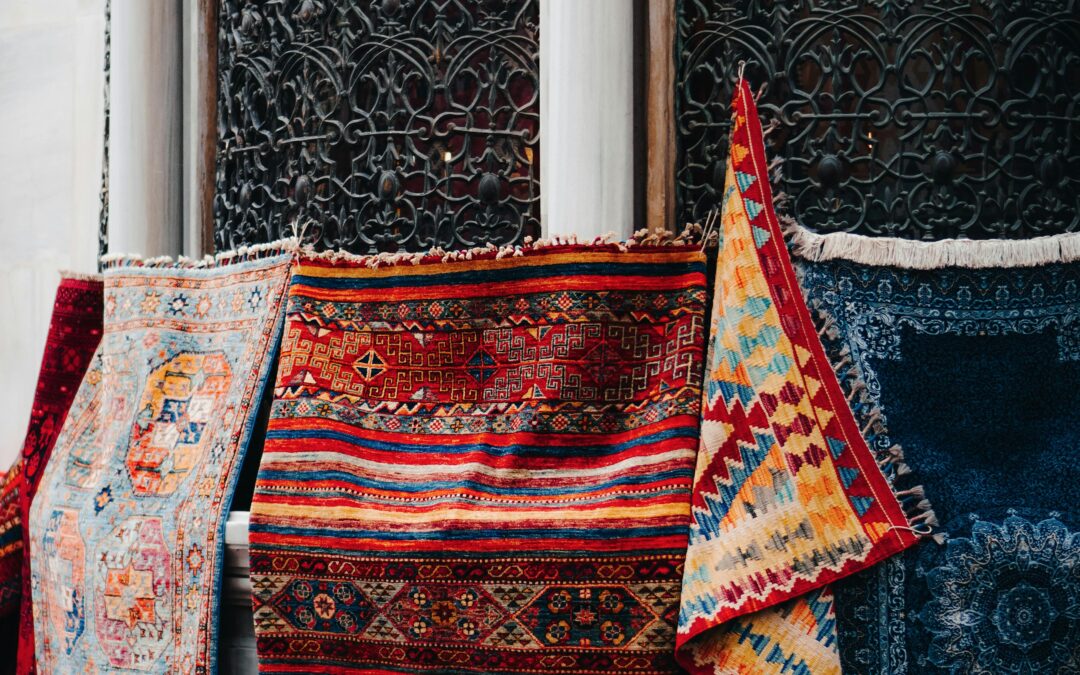
The difference between a rug that gets more beautiful over time and one that fades to a muddy gray often comes down to one question: natural dyes or synthetic?
I’ve been handling rugs long enough to see this play out in real time. A customer brings in a rug for cleaning and a consultation — it was purchased at a liquidation sale fifteen years ago, claims to be a fine Turkish piece, but something has always felt off about the color. Under good light and after a cleaning, the problem is clear: the reds have shifted orange, the blues have faded unevenly, and the whole palette has lost whatever depth it once had. Synthetic dyes, probably from the 1980s or early 1990s, from a period when quality control was inconsistent.
Then someone brings in a piece their grandmother left them — a Turkish village rug from the 1940s. Decades of use, some wear on the pile, but the colors are extraordinary. Rich, complex, full of depth. The red is still genuinely red, the indigo still has that specific blue-purple darkness that only natural dye produces. It will outlast everyone who sees it.
The dye question is central to quality, longevity, and value in oriental rugs. Here’s what you need to know.
A Brief History of Rug Dyes
For most of rug weaving’s long history, dyes came from natural sources — plants, insects, and minerals that weavers had learned to use over millennia. The traditions were sophisticated. Dyers were specialists with closely guarded formulas. The colors they achieved — the deep reds from madder root, the blue-purples from indigo, the warm golds from pomegranate and weld — defined the palette of the oriental rug world.
This changed in 1856 when the English chemist William Henry Perkin accidentally synthesized the first aniline dye (a purple called mauveine) while attempting to make quinine. Within a decade, synthetic aniline dyes had reached the rug-weaving regions of Persia and Turkey, and workshops began adopting them quickly. The early synthetic dyes were dramatically cheaper than natural dye processes and offered a much wider color range.
The problem: those early aniline dyes were unstable. They faded rapidly in light, shifted color on contact with water, and often “bled” — red would run into white or ivory pile sections when the rug got wet, permanently damaging both colors. The period from roughly 1880 to 1920 produced many beautiful rugs with dye quality issues that plague them to this day.
Later generations of synthetic dyes — chrome dyes from the 1920s onward, and modern acid and reactive dyes — were significantly more stable. A rug dyed with modern, high-quality synthetic dyes is not the same problem as one dyed with 1890s aniline dyes. But even the best synthetic dyes don’t do what natural dyes do over time.
The natural dye revival began in earnest in the 1980s and 1990s. Dealers, collectors, and connoisseurs pushed back against the synthetic dye era, and workshops in Turkey, Iran, and Afghanistan began returning to traditional methods. Cengiz was working directly with Turkish workshops during this revival period, and many of the finest modern Oushaks and other Turkish rugs today use fully natural dye processes.
How Natural Dyes Are Made
The core plant-based dyes in oriental rug weaving:
Madder (Rubia tinctorum): The source of the deep, warm reds that define Turkish and Persian rugs. The root of the madder plant is dried, ground, and used in a mordant-based dyeing process. Depending on the mordant used (alum, iron, chrome), madder produces a range from warm orange-red to deep burgundy-red to purple-red. Madder red develops beautiful patina over time — it mellows and deepens rather than fading.
Indigo (Indigofera tinctoria): The source of the blues in oriental rugs. Indigo is unusual among natural dyes — it’s insoluble in water and requires a fermentation-based reduction process to make it work. The result is a blue that ranges from pale sky to deep navy depending on the number of dye baths. Indigo in combination with yellow-dye plants produces the greens in traditional rugs. True indigo has an extraordinary depth that synthetic blues rarely match.
Pomegranate rind: The dried rind of pomegranate produces warm yellows and golds. Combined with indigo, it creates the olive and sage greens characteristic of many Turkish rugs. Combined with other mordants, it can produce dark brown tones.
Weld (Reseda luteola): A European yellow dye plant that produces cleaner, brighter yellows than pomegranate. Used in combination with indigo for a wider range of greens.
Walnut husks: The hulls of unripe walnuts produce dark brown to black tones. High in tannin, walnut dye is extremely permanent but can eventually weaken the dyed fibers (particularly when used in very high concentrations for black) — a phenomenon called “dry rot” that causes black wool in old rugs to deteriorate faster than other colors.
Cochineal: An insect-based red dye (Dactylopius coccus, from scale insects that live on cacti) that produces brilliant crimsons and pinks. Used in Persian rug weaving, particularly in the 17th and 18th centuries when it was imported from the New World through trade routes.
What Natural Dyes Do Over Time
This is the key distinction. Natural-dye rugs age beautifully. The colors mellow and harmonize — colors that may have been stronger and more distinct when the rug was new develop a patina that makes the whole palette seem to have settled into itself. Deep reds take on a warmth and complexity. Blues deepen. The overall palette of a naturally dyed rug looks better at 50 years than at 5.
Part of this is the nature of the dyes themselves. Natural dyes penetrate the wool fiber rather than just coating its surface, and the interaction between the dye, the mordant, and the wool fiber produces a complex coloring that ages differently from the surface of the fiber to its interior. Light and time bring out the depth.
Abrash — the subtle color variations visible in hand-dyed rugs — becomes more pronounced and more beautiful over time rather than looking uneven.
What Synthetic Dyes Do Over Time
Modern chrome and acid dyes, applied correctly, are reasonably stable. A high-quality modern rug with good synthetic dyes may hold its color adequately for decades. The issue isn’t necessarily that synthetic dyes are unstable — it’s that they lack the depth and complexity that natural dyes develop.
Synthetic reds don’t mellow — they fade. Synthetic blues lose their depth and can shift toward a dull gray. Colors that were vibrant and attractive when the rug was new can look flat and tired after significant use.
The more serious problem is the legacy of unstable synthetic dyes from the 1880s-1920s and from some production in the mid-to-late 20th century. Aniline and early chrome dyes are notoriously prone to running, shifting, and fading unevenly. The signature failure mode is a red that turns orange when the rug gets wet (the red and orange components of the dye separate), or a blue that fades dramatically while other colors remain stable, producing a strange discontinuity in the palette.
Bleeding: The Specific Synthetic Dye Problem
Dye bleeding — where a dark color runs into an adjacent lighter area when the rug gets wet — is almost entirely a synthetic dye problem. The specific failure: an unstable red dye that releases in water and travels into white or ivory pile, turning it pink.
This can happen during professional cleaning if not managed carefully. A reputable rug cleaner tests for bleeding before washing and takes precautions — but in rugs with severe bleeding problems, any contact with water carries risk.
Natural-dye reds that have been properly mordanted do not bleed. The dye is genuinely fixed into the fiber.
Abrash as a Quality Indicator
Abrash — the horizontal bands of slightly different color that appear in naturally dyed, hand-spun wool rugs — is something buyers sometimes worry about when they first encounter it. “Is this a defect?”
No. Abrash is a hallmark of authenticity and natural materials. Each batch of hand-spun yarn is slightly different, and each dyebath is slightly different. When a weaver runs out of one batch of yarn and ties in a new batch, the color shifts slightly. The result is those characteristic bands of variation.
Abrash gives a rug life and movement. It’s one of the qualities that makes a hand-knotted rug feel genuinely different from a machine-made piece, where color consistency is mechanically perfect and visually dead.
Significant abrash — particularly vertical variations or large color jumps — can occasionally indicate something more problematic (fading in one section of the rug, or a major repair using differently dyed yarn). A dealer should be able to explain any abrash you notice.
The Visual Test
Here’s how to assess dye quality in the store.
Compare front and back. Flip the rug over and look at the colors on the foundation side. The back of any rug is less exposed to light, so the colors should be slightly more vivid than the front — natural light fading is evidence that the surface has developed patina. If the colors on front and back are virtually identical in intensity, the rug hasn’t been used long and you can’t assess fading yet; or the dyes are very stable; or the rug hasn’t aged.
Look for depth and variation. Natural dyes produce color with visual complexity — the red in a naturally dyed rug looks like it has layers. Synthetic dyes often produce flatter, more uniform color.
Check the abrash. Subtle horizontal color variation is a good sign. Perfect uniformity across a large field of a single color suggests synthetic dyes, machine production, or both.
Ask specifically. Any reputable dealer should be able to tell you whether a rug was dyed with natural or synthetic dyes, or a combination. If the answer is vague or evasive, treat that as information.
Why Some Rugs Use a Mix
Not all rugs are purely natural or purely synthetic. Many modern production rugs use a combination — natural dyes for the primary colors (red, blue) and synthetic dyes for difficult-to-achieve natural tones (bright yellow, certain greens). This is a legitimate compromise in some cases.
The important question is whether the specific dyes used are stable and appropriate for the expected life of the rug. An experienced dealer can address this.
How Dye Type Affects Price and Value
Natural-dye rugs command a premium for two reasons: the process is more expensive and labor-intensive, and the result is objectively superior over the life of the rug. A fine modern Oushak or Turkish village rug with full natural dyes will cost more than an equivalent piece with synthetic dyes — and the premium is appropriate.
For antique rugs, dye quality is a major value driver. An antique piece with original natural dyes in good color condition is significantly more valuable than the same rug with faded, shifted, or bled synthetic dyes.
For new purchases, think of the dye premium as amortized over the life of the rug. A rug that maintains beautiful color for 50 years and develops better character over that time is a better purchase than a cheaper piece that looks decent for 10 years and then depresses you every time you look at it.
We’re happy to walk through the dye characteristics of any rug in our collection. Come see us at 3499 Sacramento St in San Francisco, Monday through Saturday, 10am to 5:45pm. Cengiz has been working with natural-dye workshops for decades and can show you exactly what the difference looks like side by side. Call us at (415) 567-1965.
Boga Rugs — San Francisco’s rug specialists since 2007. Sales, cleaning, repair, and restoration. 3499 Sacramento St, San Francisco, CA 94118.