
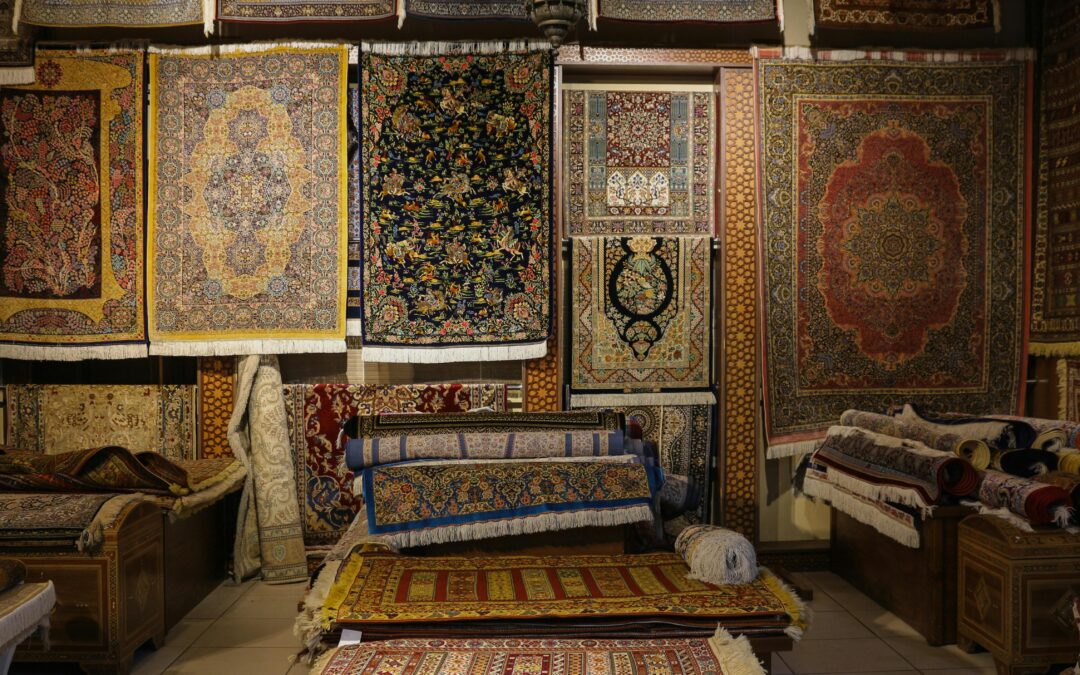
Walk into our Sacramento Street showroom and you'll see rugs from all over the world — Turkey, Iran, the Caucasus mountains, China, Afghanistan, India. To a first-time buyer, they can all look similar. "Oriental rug" seems to cover everything. But the differences matter, and once you learn what to look for, you'll start seeing rugs the way we do.
Here's a practical guide to the four main styles you'll encounter at any serious rug dealer in San Francisco.
What "Oriental Rug" Actually Means
"Oriental rug" is a broad term that traditionally refers to hand-knotted rugs from a region stretching from Turkey in the west, across Iran and Central Asia, down through India, and into China. This is the historical "rug belt" — countries where hand-knotted rug weaving has been a cultural tradition for centuries, sometimes millennia.
All oriental rugs share certain qualities:
- They're hand-knotted (or occasionally hand-woven flat, like kilims)
- They use natural fibers — wool, silk, cotton, or a combination
- They follow traditional patterns specific to their region
- They're made in small workshops or by village weavers, not factories
What distinguishes Persian from Turkish from Caucasian from Chinese comes down to three things: the knot type, the pattern tradition, and the color palette.
Persian Rugs
Persian rugs — made in Iran — are what most Americans picture when they hear "oriental rug." They're often considered the pinnacle of the craft, and for good reason: Persia has been making hand-knotted rugs for over 2,500 years.
Key Features
- Knot type: Asymmetrical (Senneh) knot, which allows for very fine detail
- Knot count: Typically 200-500 knots per square inch; master pieces can exceed 1,000
- Materials: Fine wool, sometimes silk, often on cotton foundations
- Patterns: Intricate, curvilinear, often featuring central medallions, floral vines, and garden motifs
- Colors: Rich, deep tones — burgundy, navy, gold, ivory, muted reds
Regional Styles Within Persia
Different Iranian cities developed distinct rug-making traditions, and collectors often buy Persian rugs by city:
- Tabriz — known for fine workmanship, often silk, complex medallion patterns
- Isfahan — very fine knot counts, elegant central medallions with surrounding floral work
- Kashan — traditional medallion designs in deep reds and blues
- Kerman — softer palettes, curvilinear patterns, floral
- Nain — ivory backgrounds, delicate patterns, fine silk highlights
- Heriz — bolder, more geometric, larger-scale patterns, durable wool
- Qum — fine silk rugs, very high knot counts, intricate detail
What Persian Rugs Are Best For
Formal living rooms, dining rooms, libraries, and spaces where you want to anchor the room with a serious piece. Fine Persian rugs are often considered art and can be primary visual elements in a room.
Turkish Rugs
Turkish rugs — which we specialize in at Boga Rugs — are the other major tradition of the Middle East. Turkey has been weaving rugs for as long as Persia, and while the two traditions overlap, they have distinct characters.
Key Features
- Knot type: Symmetrical (Turkish or Ghiordes) knot, which creates a slightly more structural pile
- Knot count: Typically 100-400 knots per square inch
- Materials: Wool on wool or wool on cotton, occasionally silk
- Patterns: More geometric than Persian, often featuring prayer arches, stylized floral motifs, tribal symbols, and bold border designs
- Colors: Warm, earthy — reds, rusts, golds, ivories, deep blues, forest greens
Regional Styles Within Turkey
- Hereke — the finest Turkish rugs, often silk, very high knot counts, made for royalty historically
- Oushak (Uşak) — soft, muted palettes, large-scale patterns, spacious designs. Extremely popular in modern American interiors for their calm, painterly look.
- Milas — warm earthy colors, often prayer rug format
- Konya — bold geometric patterns, tribal influences
- Sivas — fine workmanship, floral patterns, often pastel palettes
- Anatolian village rugs — folk rugs from small villages, often bolder, more rustic, with tribal symbolism
What Turkish Rugs Are Best For
Turkish rugs, especially Oushaks, have become the go-to choice for American interior designers because they pair beautifully with both traditional and contemporary furniture. Their softer palettes and slightly larger-scale patterns feel less formal than Persian rugs without losing any of the craftsmanship or beauty.
Oushaks in particular have exploded in popularity over the last 15 years. If you've seen a rug on Instagram that looks "faded, beautiful, slightly geometric, soft colors" — it's probably an Oushak.
Caucasian Rugs
Caucasian rugs come from the mountainous region between Russia, Turkey, and Iran — modern-day Armenia, Azerbaijan, Georgia, and parts of southern Russia. They have a distinct look that separates them from both Persian and Turkish rugs.
Key Features
- Knot type: Turkish (symmetrical) knot, like Turkish rugs
- Knot count: Typically lower — 80-150 knots per square inch
- Materials: Wool on wool, bold natural dyes
- Patterns: Strongly geometric, angular, often featuring stylized animals, birds, medallions, and tribal symbols. Patterns feel "drawn by hand" rather than "planned on paper."
- Colors: Vivid, high-contrast — bright reds, deep blues, ivory, strong yellows, forest greens
Common Types
- Kazak — the most famous Caucasian style, featuring bold geometric medallions, often in red, blue, and ivory, with strong tribal energy
- Shirvan — more refined, finer knot counts, often with floral and geometric patterns combined
- Kuba — intricate patterns, often featuring birds, trees, and tribal motifs
- Daghestan — prayer rug formats, fine workmanship
- Armenian — often featuring dragons, stars, and other bold figurative elements
What Caucasian Rugs Are Best For
Caucasian rugs bring energy. Their bold colors and strong geometric patterns are striking in a room, and they pair particularly well with modern and eclectic interiors. They're also often smaller (many are 4x6 to 6x9), making them great accent rugs for entries, reading nooks, and smaller spaces.
Collectors love Caucasian rugs because each one feels like a piece of folk art — no two are alike, and the weaver's personality comes through in every rug.
Chinese Rugs
Chinese rugs are the outlier in the oriental rug world. They developed in a completely different tradition, and they look it.
Key Features
- Knot type: Asymmetrical (Persian) knot
- Knot count: Varies widely; traditional rugs 80-200 knots per square inch
- Materials: Wool, silk, or a combination; often sculpted/carved pile
- Patterns: Classical Chinese motifs — dragons, phoenixes, cranes, lotus flowers, clouds, mountains, traditional symbols of longevity and prosperity
- Colors: Soft, painterly — gold, rose, peach, powder blue, ivory, jade green
Types of Chinese Rugs
- Antique Chinese (Peking, Ningxia) — traditional patterns, often with sculpted relief where the pile is carved to create a 3D effect. These are some of the most distinctive oriental rugs in the world.
- Chinese Art Deco — made from the 1920s to 1940s, often with simplified patterns and western-influenced designs. Collectible today for their unique aesthetic.
- Modern Chinese production — larger workshops, often high knot counts, sometimes copying Persian designs. Quality varies widely.
What Chinese Rugs Are Best For
Classical Chinese rugs work beautifully in spaces that welcome their specific aesthetic — homes with Asian art, antique Chinese furniture, or interiors that want a softer, more muted palette. Chinese Art Deco rugs are sought after by mid-century modern collectors and pair surprisingly well with contemporary interiors.
How to Choose Between Styles
If you're buying your first serious oriental rug, here's a simple decision framework:
Choose a Persian rug if: - You want the classic, formal "oriental rug" look - You have a traditional or transitional interior - You want the highest level of craftsmanship available - Budget allows ($3,000-$30,000+ for quality pieces)
Choose a Turkish rug (especially Oushak) if: - You want an oriental rug that looks at home in a modern or contemporary space - You prefer softer, faded palettes over bold traditional colors - You want high quality without the Persian price premium - You're decorating a large space and want a calmer visual anchor
Choose a Caucasian rug if: - You want a bold, energetic accent piece - You love folk art aesthetics - You're looking for a smaller room or accent rug - You appreciate each rug being truly one-of-a-kind
Choose a Chinese rug if: - You have Asian or mid-century decor - You want soft, muted colors rather than rich traditional ones - You're drawn to the distinctive sculpted pile of classical Chinese rugs - You want something different from the "standard" oriental rug look
The Bigger Question: New vs. Antique
Within each of these styles, you'll find both new (recently woven) and antique (50+ years old) rugs. The trade-offs:
New rugs: - Consistent condition - Brighter, truer colors - Full pile, no wear - Often lower prices
Antique rugs: - Character and patina from age - Softer, more complex colors (including natural fading) - History — sometimes traceable to a specific workshop or region - Generally higher prices for quality pieces
Neither is "better." It depends on the look you want and how you'll use the rug.
Come See the Differences in Person
Reading about rug styles is useful, but nothing replaces seeing them side by side. At our Sacramento Street showroom, we keep examples of all four traditions, and we're happy to spend as much time as you need walking through the differences.
Bring a photo of your room. Bring the rough dimensions. We'll pull rugs off the wall and roll them out on the floor so you can see them in real size and light.
Visit us: Boga Rugs 3499 Sacramento St, San Francisco, CA 94118 (415) 567-1965
Open Monday through Saturday. Free consultation, no pressure, nearly 20 years of experience helping Bay Area homeowners find the right rug.