
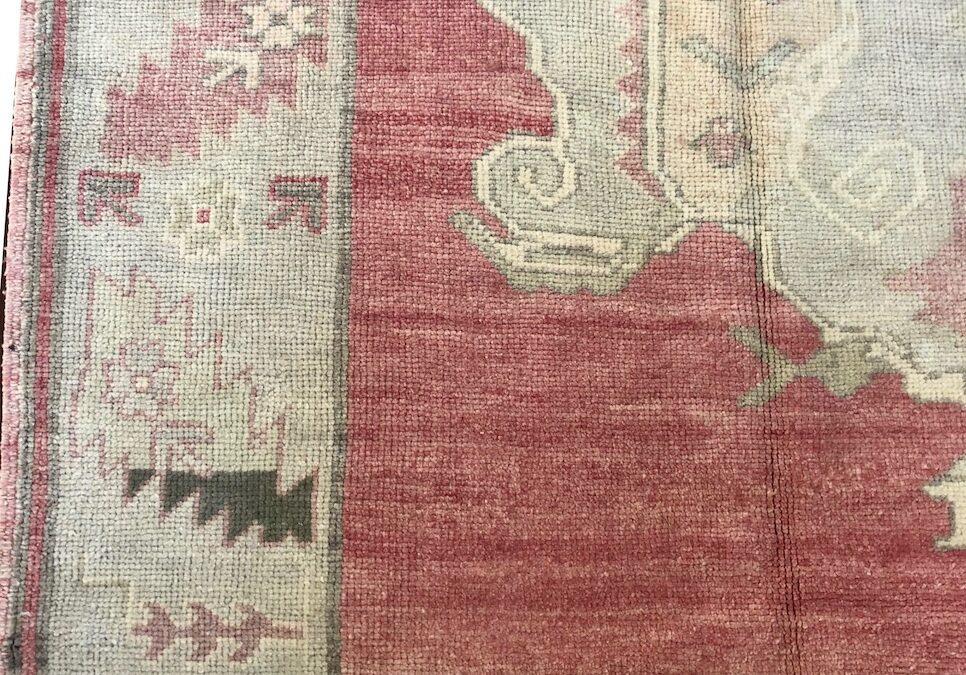
If you spend any time browsing interior design magazines, Instagram accounts, or showroom tours, you'll notice a pattern: Oushak rugs are everywhere. Not in a trendy, here-today-gone-tomorrow way — they've been a designer favorite for decades, and the obsession shows no signs of fading.
At Boga Rugs, Oushaks are our largest category. We carry nearly 500 of them at any given time. Cengiz has been importing them directly from Turkish workshops since 1989, and in that time, he's watched Oushaks go from a well-kept designer secret to the most requested rug style in our showroom. Here's why — and what you need to know before buying one.
What Makes an Oushak an Oushak
Oushak rugs come from the Usak region of western Turkey, where rug weaving has been a continuous tradition for centuries. What sets them apart from other oriental rugs is immediately visible: soft, muted color palettes, large-scale patterns, and a spacious, open quality to the design.
Where a Persian rug might pack intricate detail into every square inch, an Oushak breathes. The patterns tend to be larger — oversized medallions, loose floral motifs, or gentle arabesques that flow across the field. The colors lean toward warm golds, soft blues, faded roses, sage greens, and creamy ivories. Even when an Oushak uses deeper tones, they tend to look sun-warmed rather than saturated.
This softness isn't accidental. Oushak weavers historically used specific natural dyes and wool types that produce this exact quality. The wool from the Usak region tends to be lustrous and soft, taking dye beautifully and developing a gorgeous patina over time.
A Quick History of Oushak Weaving
The Usak region has been producing rugs since at least the 15th century, when Oushak carpets were exported to European courts and appeared in Renaissance paintings. If you've seen a Holbein or Lotto painting with an ornate rug draped over a table or beneath a throne, there's a good chance you were looking at an Oushak.
During the Ottoman Empire, Oushak workshops produced some of the finest rugs in the world, prized for their distinctive "star" and "medallion" patterns. In the 1980s, a serious revival effort brought back natural dye techniques and traditional weaving methods in western Turkey. This is the era when Cengiz first began working with Oushak workshops — and those relationships continue today.
Why Designers Specifically Love Oushaks
We sell rugs to a lot of interior designers, and the conversation about Oushaks always comes back to the same points.
They don't compete with the furniture. A busy Persian rug can dominate a room — which is sometimes exactly what you want, but it limits your furniture and art choices. An Oushak sits quietly beneath everything else, tying the room together without demanding attention. The muted palette and open patterns create a foundation, not a focal point.
They work with both traditional and contemporary interiors. This is the real magic. Put an Oushak under a tufted Chesterfield sofa with antique side tables, and it looks perfectly at home. Put the same Oushak under a clean-lined modern sectional with minimalist furniture, and it adds warmth and soul without looking out of place. Very few rug styles can make that claim.
The faded, painterly quality. Even new Oushaks have a quality that designers describe as "painterly" — the colors blend and shift across the surface rather than sitting in hard-edged blocks. Antique and vintage Oushaks take this further, with decades of natural fading creating the kind of depth you can't manufacture.
They come in large sizes. Living rooms need big rugs — 9x12 at minimum for most layouts — and Oushak weavers have always made large-format pieces. Finding an 8x10 or 9x12 Oushak is straightforward. Finding a Persian tribal rug in that size is much harder.
Oushak vs. Persian: The Key Differences
Color palette. Oushaks tend toward soft, warm, muted tones. Persian rugs often use richer, more saturated colors — deep reds, navy blues, dark greens. Both are beautiful, but they create very different moods.
Pattern scale. Oushak patterns are typically larger and more open. Persian patterns tend to be smaller and more intricate, especially in styles like Tabriz, Isfahan, or Nain.
Formality. Persian rugs generally read as more formal. Oushaks feel more relaxed and approachable. Neither is better — it depends on your room and your taste.
Wool character. Turkish Oushak wool tends to be softer and more lustrous. Many Persian rugs use a denser, more tightly spun wool. The practical difference: Oushaks often feel softer underfoot.
How to Evaluate an Oushak Rug
Wool quality. Grab a handful of the pile and feel it. Good Oushak wool is soft, lustrous, and springy. It should feel alive, not dry or brittle.
Dye type. Natural (vegetable) dyes produce the rich, complex, multi-tonal color that makes Oushaks special. Synthetic dyes produce flatter, more uniform color. How to tell: flip the rug over. If the colors on the back are brighter and more vivid than the front, that's normal — it means the surface has developed a natural patina.
Look for "abrash" — subtle variations in color within the same field. This is a hallmark of natural dyes and hand-spun wool. A rug with perfectly uniform color was either synthetically dyed or machine-made.
Knot count and construction. Flip a corner and look at the back. You should see neat, consistent rows of knots. They should be even and well-formed. Irregular or loose knots suggest lower quality.
Modern Oushaks vs. Antique Oushaks
Most Oushaks on the market today — including the majority of what we carry at Boga — are what the trade calls "modern traditional." They're newly woven, but using traditional techniques: hand-knotted on wooden looms, using hand-spun wool dyed with natural vegetable dyes, following traditional Oushak patterns.
True antique Oushaks — pieces from the 19th or early 20th century — are increasingly rare and increasingly expensive. They have a depth of patina that only time can produce, and they're genuinely one-of-a-kind. For most buyers, a well-made modern Oushak is the sweet spot: you get the beauty and character of the style in perfect condition at a more accessible price point.
Caring for Your Oushak Rug
Vacuum regularly but gently. Use the suction setting without the beater bar. Vacuum with the pile direction, not against it.
Rotate every six months to even out wear patterns and sun exposure. This is especially important if part of the rug gets more foot traffic or more direct sunlight.
Protect from direct sunlight. UV light fades even natural dyes over time. If your Oushak is near windows, use curtains or UV-filtering window film during peak sun hours.
Professional cleaning every two to three years for rugs in normal use. Oushaks with natural dyes need a cleaner who understands handmade rugs — harsh chemicals or hot water can damage the dyes. We handle this at Boga, including free pickup and delivery throughout the Bay Area.
Boga's Oushak Connection
Cengiz's relationship with Turkish Oushak workshops goes back to 1989 — long before the current designer craze made Oushaks the most-requested rug in America. He knows the families, knows the workshops, knows which regions produce which qualities. That direct connection means we can offer pieces you won't find at national retailers.
We have Oushaks in every size from scatter rugs to oversize pieces. Come see them in person — photos don't capture the texture and color depth of these rugs. Stop by our showroom at 3499 Sacramento St in San Francisco, or call us at (415) 567-1965. We're open Monday through Saturday, 10am to 5:45pm. Free pickup and delivery throughout San Francisco and the East Bay.