
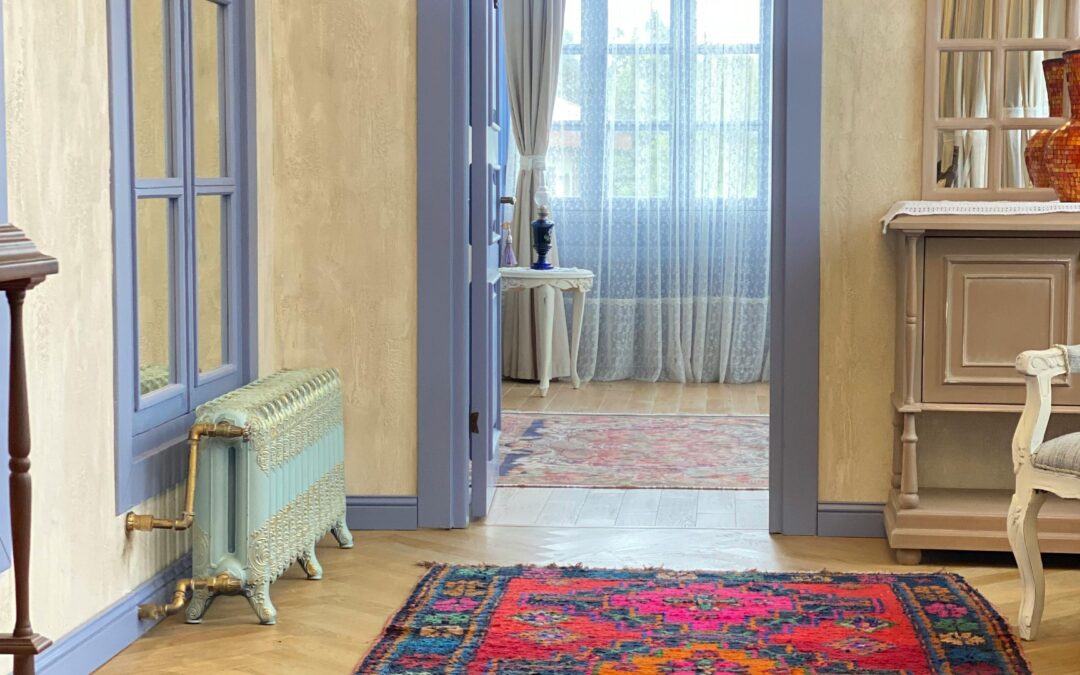
Runner rugs are one of the most practical rug purchases you’ll make — and one of the easiest to get wrong. The wrong size, the wrong pile height, or the wrong backing can turn a hallway into a tripping hazard.
We sell a lot of runners at Boga, and the questions people come in with are consistent: How long should it be? Should I get something flat or with pile? Will a traditional pattern look weird in my modern kitchen? Can you put an oriental runner on the stairs?
The good news is that runners are more forgiving than area rugs in some ways — there are fewer furniture-placement calculations to make — but the specific context (hallway, kitchen, stairs, beside a bed) each has its own set of considerations. Here’s what we tell people.
What a Runner Rug Is and Where It Works
A runner rug is a long, narrow rug typically ranging from 2 to 3 feet wide and anywhere from 6 to 14 feet long (or longer, for custom pieces). The proportions are designed for linear spaces — hallways, corridors, galley kitchens, entryways, and stairways — where a square or rectangular area rug would be the wrong format.
Runners also have secondary applications: alongside a bed (a runner on each side of a king bed is a beautiful alternative to a large area rug), in a dining room beneath a long farm table (works better than you’d think), or as an accent in a reading nook or library.
The format seems simple but the decisions matter — more so than people expect.
Sizing Rules for Hallways
The most common runner mistake: buying one that’s too short and too narrow.
Width: A hallway runner should leave roughly 4 to 6 inches of bare floor visible on each side. This means measuring your hallway width first, then subtracting 8 to 12 inches to get your target runner width. In a 36-inch-wide hallway, a 24-inch-wide runner is right. In a 48-inch-wide hallway, a 30 to 36-inch runner works. Wider runners make narrow hallways feel claustrophobic; narrower runners look like a strip of tape on the floor.
Length: Most people underestimate how long their hallway actually is. Measure the full length, then plan for the runner to leave 6 to 18 inches of bare floor at each end — or to run right up to the threshold at each end, depending on the transitions.
Standard runner lengths are 6, 8, 10, and 12 feet. If your hallway is 14 feet and you can only find a 12-foot runner, you have two options: a runner that stops short of the end walls (fine if the transition reads as intentional), or a custom length. We can help with custom sizing on many of our pieces.
Don’t buy short. A runner that ends several feet before the end of a hallway looks like a mistake. When in doubt, go longer.
Kitchen Runners: Practical Considerations
Kitchen runners serve a different purpose than hallway runners — they’re primarily about comfort underfoot during cooking and cleanup, and only secondarily about aesthetics.
The anti-fatigue quality of a runner in front of a sink or stove is real. Standing on a hard tile or hardwood floor for 30 to 60 minutes of food preparation is genuinely tiring; a rug with any pile absorbs some of that impact.
Pile height: In a kitchen, lower pile is better. Lower pile is easier to clean, doesn’t trap food particles as deeply, and is less likely to be a tripping hazard when wet or when you’re moving quickly.
Flatweave kilims are excellent kitchen runners. They’re thin enough to lie flat without buckling, easy to shake out or spot-clean, and durable under foot traffic. A kilim in a kitchen also adds a traditional warmth that the room often needs.
What to avoid near water: Very high pile, delicate antiques, and light-colored rugs in cream or ivory (cooking is hard on light colors). Also avoid rubber-backed rugs directly on hardwood — the rubber can react with wood finishes over time.
Cleaning access: Kitchen runners need more frequent cleaning than other rugs. Make sure whatever you choose can be professionally cleaned easily and that you have a realistic plan for managing spills between cleanings.
Stair Runners: Special Considerations
Stair runners are among the most demanding applications for a rug, and they require specific planning.
Securing method: A stair runner needs to be secured — either by tack-strip installation underneath the carpet (the most permanent and professional method), by stair rods (decorative metal rods that pin the runner at each nosing), or by strong double-sided stair tape (for lighter traffic or temporary installations). An unsecured stair runner is a genuine fall hazard.
Pile direction: Install the runner so the pile direction runs downward — when you brush your hand down the stairs, the pile should lie flat (not push back against your hand). This is the natural wear direction and means the pile wears more evenly.
Nosing coverage: The nosing — the rounded front edge of each step — takes the most wear and should be fully covered by the runner. If the runner is too narrow to wrap around the nosing, it will wear through there first. Many stair runners are sized slightly wider than necessary specifically to ensure good nosing coverage.
Length calculation: Measure each step individually — the tread depth plus the riser height, plus a few inches for any tucking under at the top and bottom. Multiply by the number of steps. Add 10-15% for error. Stairs look simple but the geometry of fitting a long continuous runner into a staircase requires careful calculation.
Pile height for stairs: Medium pile works well — not so low that it provides no cushion or warmth, not so high that it’s soft and unstable underfoot. Very thick, plush pile is unsafe on stairs.
Styles That Work Well as Runners
Kilim and flatweave: The most practical and versatile choice. Kilims are thin enough to lie flat without buckling, easy to clean, and available in a wide range of patterns and colors. A traditional geometric Turkish kilim in a hallway adds warmth and character without being fussy.
Traditional orientals for hallways: A traditional hand-knotted runner in Turkish or Persian style — geometric borders, a patterned field, warm colors — is a classic choice for a traditional or transitional home. Heriz-style runners are particularly good here: bold, durable, and forgiving of wear.
Tribal runners for a bold statement: A Caucasian or Central Asian tribal runner — bold geometric patterns, high contrast — makes a hallway into a design moment. This only works if the rest of the space can hold the visual weight.
Simple, solid-toned runners: Sometimes the hallway needs to transition gracefully between rooms rather than make its own statement. A runner in a single color or minimal pattern can serve this purpose while still providing the practical benefits.
Pile Height Considerations
For high-traffic hallways: Lower-to-medium pile is more practical. Lower pile shows wear more slowly (there’s less pile to compress), is easier to vacuum, and creates a safer surface for people moving quickly.
For under-door clearance: If a runner needs to fit under a door, measure the clearance between the floor and the bottom of the door when fully open. A runner with thick pile may prevent the door from opening fully or create drag. Low-pile flatweave runners typically have no under-door issues.
For comfort: A bedroom runner alongside a bed benefits from some cushion — waking up and putting bare feet on a soft, warm runner is a genuine luxury that a flat kilim doesn’t provide in the same way. Medium pile makes more sense here.
Rug Pad Options for Runners
Runners need non-slip backing more than almost any other rug application — a hallway runner that shifts underfoot is a fall waiting to happen.
Gripper pads: Available in custom-cut lengths, non-slip rubber gripper pads are the standard solution for runners on hardwood, tile, or vinyl floors. They prevent movement in all directions without damaging the floor finish.
Double-sided carpet tape: Works well for securing the ends of a runner that’s otherwise padded but tends to lift at the corners. Choose a tape formulated for rugs — regular masking or packing tape leaves residue on floors.
Stair pads: Stair runners require specialized padding — thin, low-profile pads cut to the tread dimensions — if they’re not being installed with tack strips. Thick area rug pads are wrong for stairs.
Rug-on-carpet pads: If you’re placing a runner over wall-to-wall carpet, you need a different pad type than for hard floors. These grippers work by creating friction between the runner and the carpet rather than adhering to the floor.
Finding the Right Length
Standard runner lengths work for most applications, but “most” leaves a meaningful percentage of hallways, staircases, and kitchens that need something different. If your space calls for a 13-foot runner, your options are:
- Join two shorter runners end-to-end with a small gap between them (works in long hallways with a doorway or other natural break point)
- Order a custom length (we can assist with this for many of our pieces)
- Accept a runner that’s somewhat shorter than ideal and compensate with thoughtful placement (ending the runner at a threshold or entry point rather than mid-hallway)
Call us before you buy anything custom — we’ve helped customers solve a lot of these unusual sizing situations and can often find a stock piece that works better than expected.
Care and Cleaning for Runners
Runners take more concentrated abuse than area rugs. A hallway runner may have more foot traffic per square foot than almost any other surface in the home — it’s walked on by everyone who comes through, every day, in whatever shoes or boots they’re wearing.
Vacuum more frequently. A runner in a high-traffic hallway should be vacuumed at least twice weekly. Dirt and grit that isn’t removed works down into the pile and becomes abrasive.
Rotate when possible. Unlike a fixed area rug, many hallway runners can be reversed (turned 180 degrees end-to-end) to distribute wear. The entry end of a hallway runner always takes more abuse than the far end. Rotating annually extends the life of the piece significantly.
Professional cleaning more frequently. A heavily used hallway runner probably needs professional cleaning annually, versus every two to three years for a lightly-used area rug. We offer free pickup and delivery throughout San Francisco and the East Bay, so bringing a runner in for cleaning is no harder than a quick phone call.
Watch the ends. The fringe and end finish of a runner take wear from foot traffic. Check periodically that the fringe isn’t being walked on and fraying, and that the end finish is secure.
Come into our showroom at 3499 Sacramento St and see what we have in runners — we carry a range of widths and styles, and we can help you figure out what works for your specific application. Monday through Saturday, 10am to 5:45pm. Call us at (415) 567-1965.
Boga Rugs — San Francisco’s rug specialists since 2007. Sales, cleaning, repair, and restoration. 3499 Sacramento St, San Francisco, CA 94118.